


 DVI cable and adapter
VGA cable and adapter
AV cables
cable without plugs
AUX cable
AV cable
B&O audio cable
Multi channel audio cable
Subwoofer audio cable
Turntable audio cable and plugs
Analogue audio distribution and convertion
Colored ethernet cables
Power cable without connectors
Power connector / plug
Power adaptor
Low voltage DC cable, plug and adapter
12V trigger cable
DC cables
Solar cables
DC plugs
SATA power cable
Molex power cable
Remote control
DVI cable and adapter
VGA cable and adapter
AV cables
cable without plugs
AUX cable
AV cable
B&O audio cable
Multi channel audio cable
Subwoofer audio cable
Turntable audio cable and plugs
Analogue audio distribution and convertion
Colored ethernet cables
Power cable without connectors
Power connector / plug
Power adaptor
Low voltage DC cable, plug and adapter
12V trigger cable
DC cables
Solar cables
DC plugs
SATA power cable
Molex power cable
Remote control

NOTE: The component video standard has more or less been phased out in favor of HDMI. Therefore, the selection of cables, connectors and adapters is unfortunately quite limited.
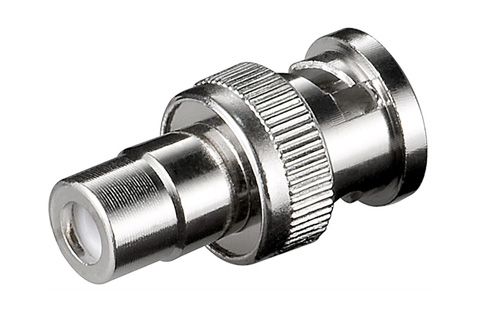
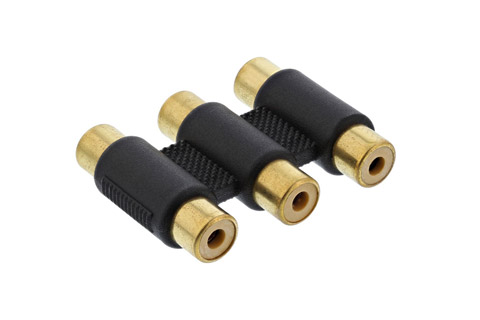
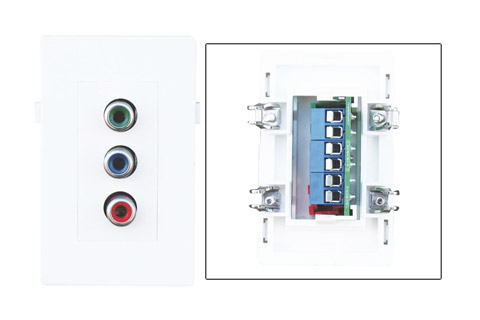
Component/component video signals were primarily used in connection with better video equipment, such as DVD players, projectors and flat screens. The component standard was therefore also something close to the top in analog video transmission. The standard is originally from the USA and actually corresponds to the European RGB video standard, which was used in Scart cables, but should not be confused with it. The component signal is a lossless compressed RGB signal using only 3 conductors with the sync signal integrated, where RGB in Scart cables has separate sync.
Component and RGB video transfers stand out by giving a visibly more colourful and calm image, yet less noise than both composite and S-video transfers, and are clearly recommended if possible. In addition, Component video is able to carry a true HD signal up to 720p (progressive) or 1080i (interlaced) resolution, unlike the others which only go up to 480p (NTSC) or 576p (PAL).
For transmission of component video signals, as for all other analogue video signals, coaxial cables with an impedance of 75 ohms are used for optimum quality. If the cable does not have the correct impedance, it will often result in shadows in the image. Component cables do not transmit audio signals, which are usually routed as a separate cable.

 |
COMPOSITE VIDEO KABEL |
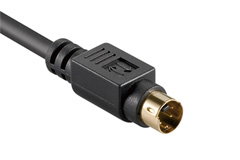 |
S-VIDEO CABLE AND PLUGS |
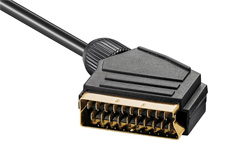 |
SCART CABLE AND PLUGS |
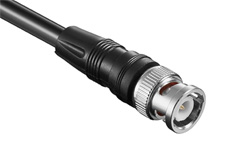 |
SDI CABLE AND PLUGS |
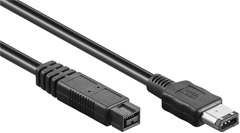 |
FIREWIRE (DV) CABLE |
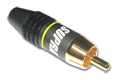 |
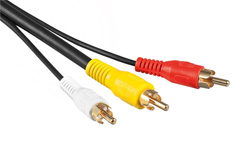
AV PLUG AND CONNECTOR |
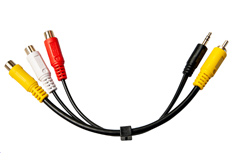 |
AV ADAPTER AND CONVERTER |











































AV-Connection A/S • VAT no.: DK27907547 • Kaervej 71-73 • 6400 Soenderborg • Denmark • Tel. +45 7442 1078 • E-mail: [email protected]


 HIFI STEREO